

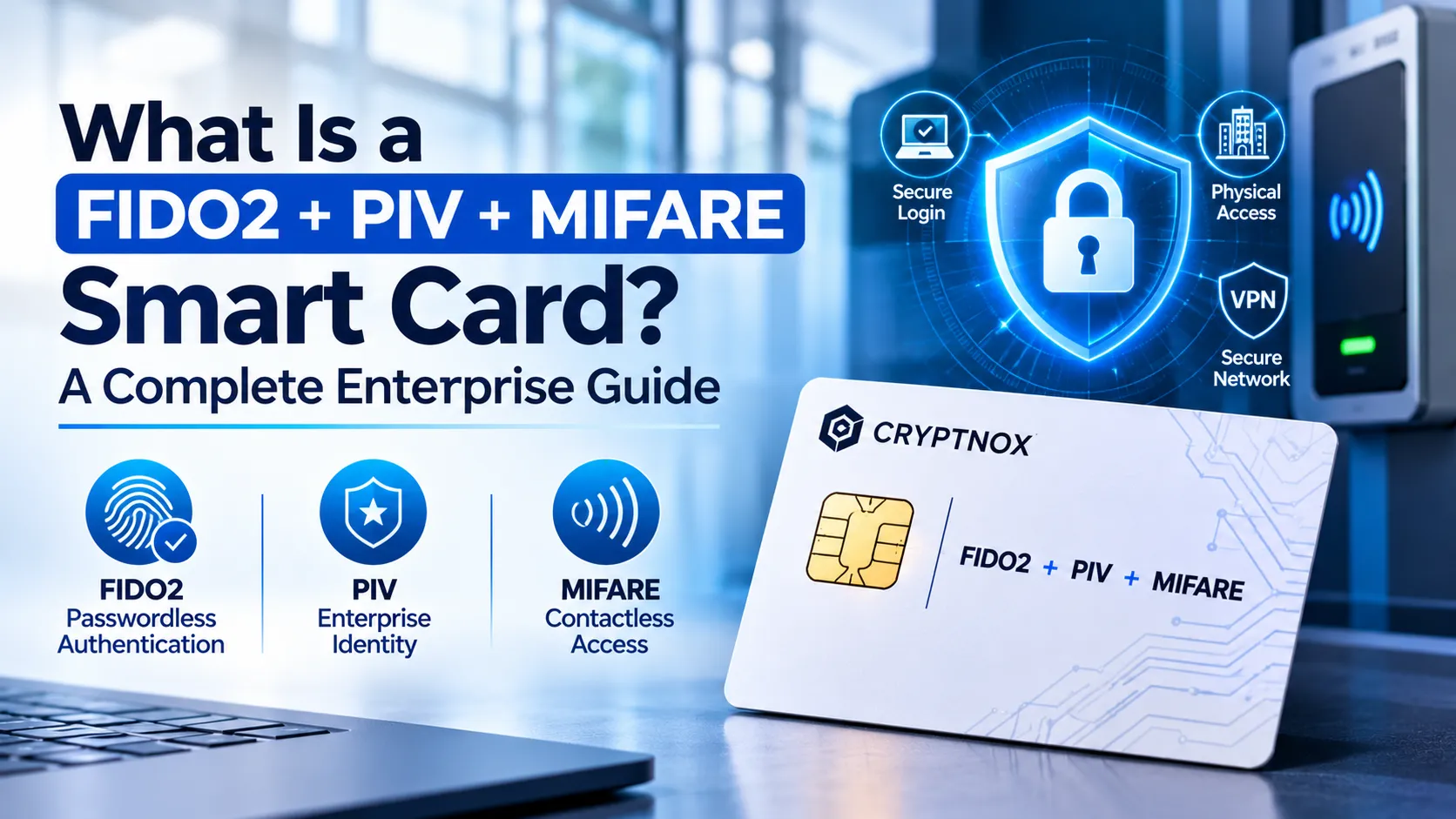
A FIDO2 PIV MIFARE card combines three different technologies to support digital authentication, enterprise identity verification, and physical access control through a single smart card. Instead of issuing separate credentials for logging into computers, authenticating to enterprise systems, and entering secured buildings, organizations can use a compatible multi-technology card to support these functions within one credential.
Each technology serves a different purpose. FIDO2 enables passwordless authentication, PIV supports certificate-based identity verification through public key infrastructure (PKI), and MIFARE provides contactless identification and access-control capabilities.
For enterprises managing employees, contractors, IT administrators, and restricted facilities, understanding how these technologies work together is essential when planning an integrated identity and access management system.
What Is a FIDO2 PIV MIFARE Card?
A FIDO2 PIV MIFARE card is a multi-technology smart card that combines three authentication and identification standards or technology families.
Its purpose is to support different security requirements through a common physical credential.
The three technologies provide distinct capabilities:
-
FIDO2: Supports passwordless authentication and phishing-resistant login for compatible applications and services.
-
PIV: Supports certificate-based authentication, digital identity verification, and cryptographic operations using PKI credentials.
-
MIFARE: Supports contactless identification and physical access-control applications, depending on the card variant and reader infrastructure.
A FIDO2 PIV MIFARE card can therefore serve as a foundation for consolidating multiple employee credential functions.
However, combining these technologies does not automatically mean every application or access-control system will work without configuration. Compatibility depends on the card implementation, supported protocols, readers, operating systems, and enterprise infrastructure.
Understanding the Three Technologies
1. FIDO2: Passwordless Digital Authentication
FIDO2 is an authentication standard designed to reduce dependence on traditional passwords. It consists of WebAuthn and the Client to Authenticator Protocol (CTAP).
During registration, a FIDO2 authenticator creates a cryptographic key pair for a service. The public key is registered with that service, while the private key remains protected by the authenticator.
During subsequent authentication, the service sends a challenge that the authenticator signs using the private key. The service verifies the signature using the registered public key.
This approach helps prevent phishing because authentication is cryptographically bound to the legitimate website or service origin.
For enterprise environments, FIDO2 can support:
-
Passwordless employee login.
-
Secure access to compatible cloud applications.
-
Multi-factor authentication.
-
Administrator authentication.
-
Reduced exposure to password reuse and credential phishing.
2. PIV: Certificate-Based Enterprise Identity
PIV stands for Personal Identity Verification. It is a smart-card credential framework associated with FIPS 201 and used for identity verification and authentication.
PIV uses digital certificates and cryptographic keys to establish trust between a user and an enterprise system.
A PIV-compatible card can store certificates and protect associated private-key operations. Depending on the implementation, these credentials can support:
-
Certificate-based computer login.
-
VPN authentication.
-
Enterprise Wi-Fi authentication through EAP-TLS.
-
Secure email signing and encryption.
-
Authentication to PKI-enabled enterprise applications.
For example, an IT administrator connecting remotely to a corporate VPN may be required to present a valid certificate and prove possession of the corresponding private key.
This provides stronger identity assurance than relying on a password alone, provided certificate validation and access policies are correctly configured.
3. MIFARE: Contactless Physical Access
MIFARE is a family of contactless technologies commonly used in identification and access-control applications.
Depending on the specific variant and implementation, MIFARE-based credentials can support building entry, employee identification, and compatible access-control systems.
For example, an employee may use a contactless card at a compatible office reader to request access to an authorized entrance.
MIFARE functionality is distinct from FIDO2 and PIV. Its capabilities depend on the card variant, security configuration, reader support, and access-control software.
Organizations should verify compatibility with their existing physical access infrastructure rather than assuming every MIFARE card works with every reader.
How Do These Technologies Work Together in an Enterprise?
The main advantage of a combined smart card is the ability to support multiple credential workflows through one physical device.
Consider an employee working in a corporate office.
In the morning, the employee presents the card to a compatible building reader for physical access. After reaching the workstation, the employee uses the FIDO2 functionality to authenticate to a supported application without entering a password.
Later, when accessing a corporate VPN, the employee uses the PIV certificate for certificate-based authentication.
These are separate authentication processes, but they can use capabilities provided by the same physical credential.
This model can simplify credential distribution and help organizations establish consistent identity policies across physical and digital environments.
A FIDO2 PIV smart card can be considered when evaluating this type of integrated credential architecture.
Why Enterprises Are Considering Multi-Technology Smart Cards
Simplified employee credential management
Managing separate cards, tokens, and authentication devices can create administrative overhead. A combined credential can reduce the number of physical items employees need to carry.
Stronger digital access controls
FIDO2 and PIV provide different cryptographic authentication mechanisms. Organizations can select the appropriate method based on application requirements, identity assurance, and security policies.
Integrated physical and digital identity
Combining contactless access with digital authentication can support a more unified employee identity strategy.
Support for enterprise security policies
A properly implemented enterprise PIV smart card can form part of a broader security architecture involving PKI, identity management, access control, and endpoint security.
However, organizations must still maintain appropriate credential revocation, employee offboarding, PIN management, and device replacement procedures.
What Should IT Teams Check Before Deployment?
Selecting a multi-technology smart card requires technical evaluation beyond its advertised features.
IT and security teams should assess:
-
FIDO2 compatibility: Confirm support for the required WebAuthn and CTAP workflows.
-
PIV implementation: Verify certificate profiles, cryptographic algorithms, key management, and supported authentication applications.
-
MIFARE compatibility: Identify the exact card technology and confirm compatibility with existing readers.
-
PKI infrastructure: Ensure certificate issuance, renewal, revocation, and validation processes are established.
-
Endpoint integration: Test operating system support, middleware, drivers, and reader interfaces.
-
Security management: Establish procedures for lost cards, compromised credentials, PIN resets, and employee departures.
Testing should cover real enterprise workflows, including workstation authentication, remote VPN access, enterprise Wi-Fi, and physical entry.
Conclusion
A FIDO2 PIV MIFARE card combines three complementary technologies to support passwordless authentication, certificate-based digital identity verification, and contactless physical access control.
FIDO2 helps protect online account access, PIV supports PKI-based enterprise authentication, and MIFARE enables compatible physical identification and access-control applications. Together, they can provide a more consolidated credential approach for organizations managing both digital and physical security.
However, successful deployment depends on compatibility, secure configuration, certificate lifecycle management, and appropriate access policies. Enterprises should evaluate each technology independently before integrating them into a common identity architecture.
For IT teams planning modern employee credential systems, a PIV and FIDO2 smart card offers an approach worth evaluating when multiple authentication requirements need to be addressed through one physical credential.
