

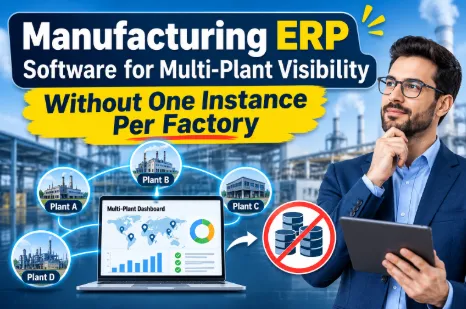
Multi-plant growth outpaces most manufacturers’ original ERP plans. A plant that starts in one location often adds a second or third site within a few years. Organic growth or an acquisition usually drives the expansion.
Most manufacturers respond by giving each new factory its own system. In 2026, that decision is exactly where manufacturing ERP software choices start to go wrong.
Running a separate instance per plant feels safer at first. That decision has a cost. Leadership loses visibility into production, inventory, and quality data across the business. Getting a straight answer means waiting for someone to compile a spreadsheet.
This is not the same problem as subsidiary-level financial consolidation, where separate legal entities report through a holding structure. Multi-plant production visibility is an operational challenge, not a financial one. It means seeing what happens on every plant’s shop floor, in near real time, from one place. Each plant still runs its own day-to-day schedule underneath that shared view.
Why “One Instance Per Factory” Breaks Down
When each plant gets its own ERP instance, the logic usually sounds reasonable. Plant managers want control over their own configuration. IT teams want to isolate risk. Nobody wants one outage to stop every factory at once.
The costs show up later. Item masters drift apart, so the same raw material ends up with three different codes across three plants. Nobody can compare production schedules side by side.
Surplus stock at one location cannot fix a shortage at another location. This happens because neither system is aware that the other one exists. Over a years this problem creates real expenses. These expenses include shipping costs buying the same thing more, than once and not delivering on time.
-
Duplicate master data for materials, vendors, and routings across every plant instance
-
No shared view of capacity, so overtime gets approved at one site while another sits underutilized
-
Consolidated reporting that depends on manual exports, spreadsheets, and someone’s Friday afternoon
-
Upgrade and patch cycles that multiply with every added instance, each with its own testing burden
What Production Visibility Across Plants Requires
Production visibility across plants means more than a dashboard on top of disconnected systems. It requires a shared data model. A work order, a bill of materials, or a quality hold then means the same thing everywhere. It makes no difference whether the record originates in Plant A or Plant C.
Without that shared structure, any reporting layer on top just repeats the same spreadsheet problem, dressed up. The dashboard changes. Someone still has to reconcile the underlying data by hand before anyone trusts it.
Three things define whether visibility is real or cosmetic. The business needs one source of truth for inventory and production status. Each plant needs to keep its scheduling autonomy day to day. Leadership needs to compare performance across sites using identical metrics.
Miss any one of these, and the team ends up back where it started. Someone reconciles the numbers by hand before every board meeting.
“The majority (80%) of manufacturers plan to invest 20% or more of their improvement budgets in smart manufacturing initiatives, with a focus on foundational tools and technologies.” Source: Deloitte, 2026 Manufacturing Industry Outlook (2025 survey of 600 manufacturing executives)
That level of investment only pays off if the underlying systems can share data. A foundational tool sitting inside an isolated plant instance cannot feed a company-wide view. That holds true no matter how much budget goes toward it.
Single ERP Instance, Plant-Level Autonomy: How It Works
The alternative to one instance per factory is not a rigid, centralized system that strips plant managers of control. A single ERP instance with plant-level segmentation built in works differently.
Each site keeps its own production calendar, workforce, and approval chain. They share one data structure underneath. That structure makes cross-plant reporting, inventory transfers, and quality roll-ups possible without a manual step in between.
Manufacturers weighing this choice usually land on one of three models. A fully centralized, single configuration keeps data consistent, but it strips away local flexibility. Plants often find workarounds outside the system.
One instance per factory keeps full plant autonomy, but it needs manual work to consolidate reporting. A single instance with plant-level segmentation combines both: one shared data model, with each site still configured its own way.
-
One instance per factory: full plant autonomy, but low data consistency and manual reporting effort
-
Fully centralized, single configuration: high data consistency, but low plant autonomy
-
Single instance, plant-level segmentation: high data consistency and high plant autonomy, with native cross-plant reporting
This is where custom-configured manufacturing ERP software earns its cost. Arobit builds it around how each plant works. A packaged, one-size-fits-all setup rarely maps cleanly onto three or four plants with different production processes.
A system built on a shared instance gives operations leaders one place to look. It does not force every site into an identical mold to get there.
A Realistic Multi-Plant Scenario
Consider a mid-sized manufacturing group running three production units across neighboring states, each added through expansion over roughly six years. Each plant had its own legacy system by the time leadership decided to consolidate.
Inventory counts were inconsistent across sites. It took the finance team nearly a week to close month-end numbers. The team had to reconcile plant-level data by hand before it meant anything at group level.
The group moved to a single ERP instance with plant-level segmentation. Month-end close time dropped from roughly a week to two or three days. Materials could move between plants when one site ran short, something nobody could see until a production line stopped.
This pattern is common among mid-market manufacturers scaling site by site rather than starting multi-plant from day one. The underlying trade-offs hold regardless of which industry the plants operate in.
Evaluating Manufacturing ERP Software for a Multi-Plant Rollout
Choosing manufacturing ERP software for a multi-plant environment is a different exercise than choosing it for a single site. The evaluation needs to test for cross-plant behavior specifically, not just feature checklists built around a single factory.
-
Can the system support one shared item master with plant-specific attributes, rather than duplicate records per site
-
Does production scheduling stay local to each plant while feeding a consolidated capacity view
-
Can teams view, and where appropriate transfer, inventory across plants without manual reconciliation
-
Does quality and compliance data roll up consistently, especially for regulated or export-facing manufacturers
-
What does onboarding a new plant into the existing instance actually require, in time and cost
Research on shared-services ERP strategy consistently finds one thing. The instance decision matters less than how well the model fits the business. A single instance without proper plant segmentation can end up just as disconnected as separate systems.
Common Pitfalls When Consolidating Plants Under One Instance
Manufacturers moving from separate plant systems to one ERP instance tend to repeat a few avoidable mistakes. The most frequent one is treating the migration as a pure IT project. Plant managers rarely get a say in how their workflows will map to the new structure.
Rushing the master data cleanup is a close second. Duplicate item codes, vendor records, and routings often carry over unresolved. The new single instance then inherits the old problem under a shared login.
Cleaning that data before go-live, plant by plant, takes longer. It delivers the visibility the project was meant to create. A third mistake is rolling out every plant at once instead of phasing the migration. That approach multiplies the risk of one bad cutover disrupting production across the whole group.
Frequently Asked Questions
Q: What is a multi-plant ERP system?
A multi-plant ERP system is a software instance that supports two or more physical manufacturing sites. Each manufacturing site keeps its production schedule, workforce and approvals. All manufacturing sites share one underlying data structure for materials, inventory and reporting, in the -plant ERP system.
Q: Should every factory have its own separate ERP instance?
Not usually. Separate instances give each plant configuration independence. But they make cross-plant reporting, inventory sharing, and master data consistency hard to maintain. A single instance with plant-level segmentation typically delivers both local flexibility and group-wide visibility.
Q: How long does it take to consolidate multiple plants onto one ERP instance?
Timelines vary with the number of plants and the state of existing master data. A phased rollout, one plant at a time, generally takes several months per site rather than a single company-wide cutover. Master data cleanup is usually the largest time factor.
Arobit Business Solutions works as a technology partner rather than a software vendor. It configures manufacturing ERP software around how each plant operates, instead of forcing every site into an identical template. Arobit built that approach over 13+ years of enterprise technology consulting. It lets growing manufacturers add plants without losing visibility across the group.
Modernize your manufacturing operations by evaluating whether your current ERP setup can support production visibility across every plant you run.
